Aerogel Powder
Nano-porous silica aerogel particles. Supplied in three grades — Hydrophilic, and Hydrophobic-50 and -100 — with a thermal conductivity of 0.021–0.025 W/m·K at 25℃ and a porosity above 90%. Blended with paints, resins, or rubber for insulating coatings and composite materials.
Overview
What is aerogel powder?
High-performance thermal insulation with an ultra-low-density, highly porous structure.
Aerogel powder consists of nano-porous silica aerogel particles — a powder material that delivers excellent insulation performance through low density, small pores, high specific surface area, and high porosity.
- A lineup suitable for the structural, filling, and composite layers of insulation equipment
- Selectable by hydrophilic or hydrophobic surface property and by particle size range
- Applications: insulating coatings, sound-absorbing and sound-blocking materials, foam sheet fillers, and more
- Additional grinding, classification, and particle size customization available on request
Key terms — nano-porous · low thermal conductivity · high specific surface area · high porosity
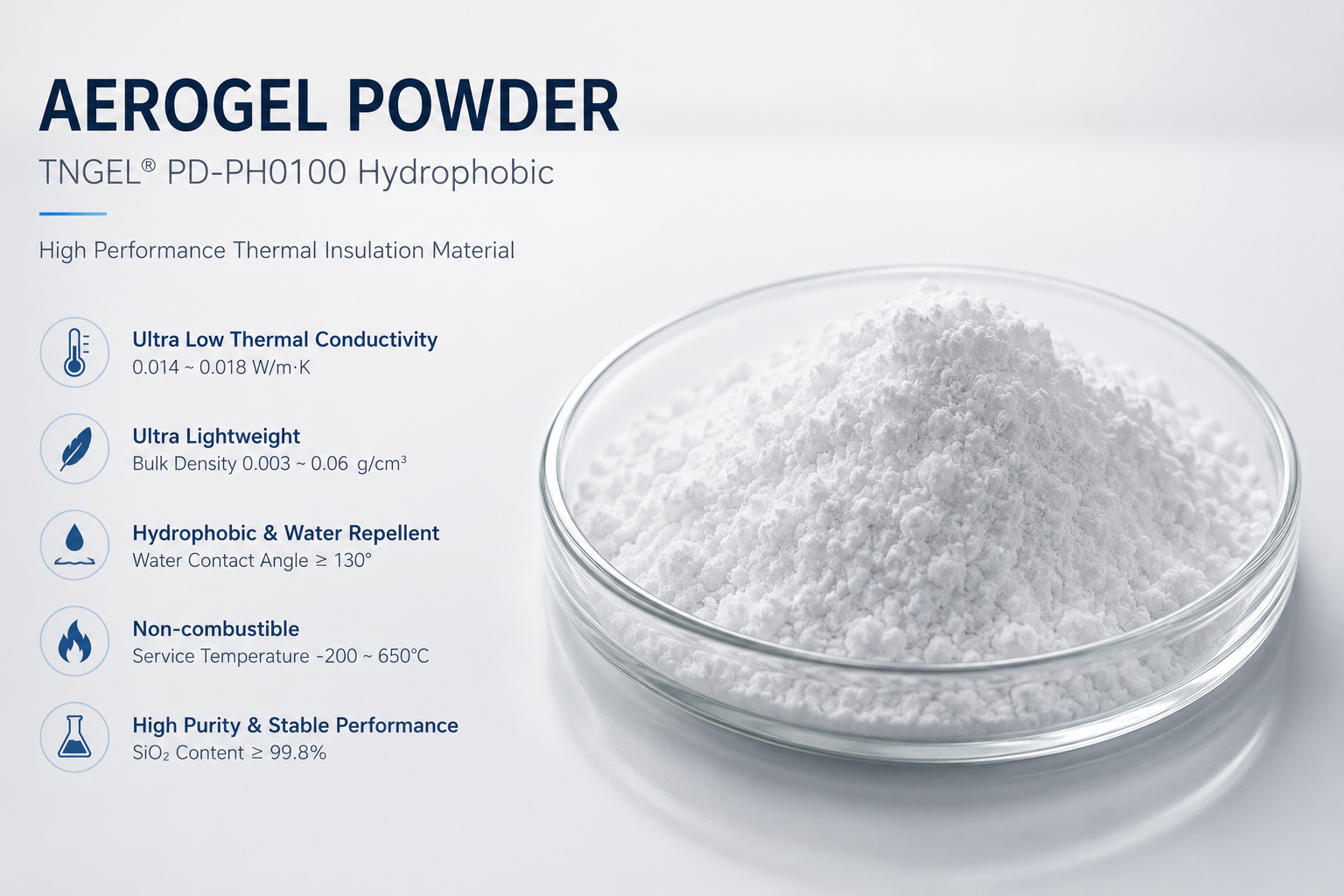
Characteristics
Three characteristics
Used in heat-resistant design studies on the strength of insulation properties that suppress heat transfer in high-temperature environments.
Differing surface properties to suit the application widen the range of choice in composite and filler layer design.
Offers a low thermal conductivity range of 0.021–0.025 W/(m·k) at 25℃.
Applications
Main applications
| Insulating paint | Can be considered as a surface insulation coating material for buildings, plant, piping, tanks and the like. |
|---|---|
| Functional coatings | Applicable to coating compositions intended to block heat, lower surface temperature, and reduce condensation. |
| Composite materials | Usable as a filler or lightweight insulating additive in resins, rubber, plastics, sealants and the like. |
| Industrial insulation | Can be considered as a supplementary or reinforcing insulation material around high-temperature equipment. |
Data Sheet
Lineup properties
Three grades — Hydrophilic · Hydrophobic-50 · Hydrophobic-100
| Item | Hydrophilic | Hydrophobic-50 | Hydrophobic-100 | Standardization |
|---|---|---|---|---|
| Specific surface area (m²/g) | 600~1000 | 800~1000 | 800~1000 | GB/T 19587-2004 |
| Bulk density (kg/m³) | ≤40~150 | ≤35~45 | ≤55~65 | GB/T 5211.4-1985 |
| Thermal conductivity (25℃) | ≤0.025 | ≤0.021 | ≤0.021 | ISO 22007-2-2008 |
| Porosity (%) | >90 | >90 | >90 | Matrix density backstepping |
| Pore size (nm) | 20~50 | 20~50 | 20~50 | Nitrogen adsorption and desorption |
| Particle size (µm) | 15, 35 | 15, 35 | 50~100 | GB/T 19077-2016 |
| Surface property | Hydrophilic | Hydrophobic | Hydrophobic | GB/T 30693-2014 |
| Color / packaging | White / 8 kg carton box | White / 8 kg carton box | White / 8 kg carton box | On customer request |
Process
How aerogel is made
A sol-gel reaction creates the pore structure, and supercritical drying converts the liquid to gas without collapsing that structure.
- 01. Sol-gel reaction
A precursor and solvent are mixed to form a sol, which develops into a gel network.
- 02. Aging and solvent exchange
The pore structure is strengthened and the internal liquid is exchanged for alcohol, liquid CO₂, or similar.
- 03. Supercritical drying
Surface tension is eliminated so the liquid converts to gas without collapsing the structure.
- 04. Finished aerogel
The result is an ultra-light, ultra-insulating structure with a porosity above 90%.
The key step — supercritical drying
- Conventional heat drying can shrink or crack the gel because of surface tension.
- Raising temperature and pressure past the critical point removes the boundary between liquid and gas.
- Slowly removing the solvent in this state allows drying while the nano-pore structure is preserved.
※ Actual suitability may vary with the customer's binder, solvent, dispersion conditions, and target properties. We recommend confirming suitability through a sample test.
Safety
Handling and storage
- Take care to avoid dust inhalation and contact with skin or eyes
- Protective equipment such as gloves, a mask, and safety goggles is recommended
- Ventilation is required in production and use environments
- Store dry in a sealed container, away from volatile substances
- Keep sharp objects away from the packaging
Downloads
Related downloads
- PDF[GHT 2026] Aerogel Powder Product BrochureDownload ↓
Related
Other products in this line
White Fused Alumina
/materials/white-fused-aluminaDetails →Silica Aerogel Blanket
/materials/silica-aerogel-blanketDetails →SiC / Silicon Carbide
/materials/silicon-carbideDetails →MAFTEC Alumina Fiber Blanket
/materials/maftec-alumina-fiber-blanketDetails →AFPW Ultra-Thin Insulation Sheet
/materials/afpw-insulation-sheetDetails →Inquire about Aerogel Powder specifications
Share your application, specifications and required quantity. We’ll help you choose a product suited to your process and operating environment.